

 Español
 Português
 لالعربية
 Русский
 Bahasa Indonesia
 Français
 Türkçe
 Bahasa Melayu
 adss-s-1.jpg" width="500" height="500"/>
If you're sourcing ADSS cable for a utility, telco, or EPC project, don't start with how many fibers you need. That's backwards. Start with the span length. Then check the voltage or electrical environment. Only after that should you settle on fiber count and cable construction.
That's actually how real overhead projects specify ADSS. IEEE 1222-2019 treats ADSS as an overhead utility cable, so it covers mechanical, electrical, and installation requirements together - not just optical specs.
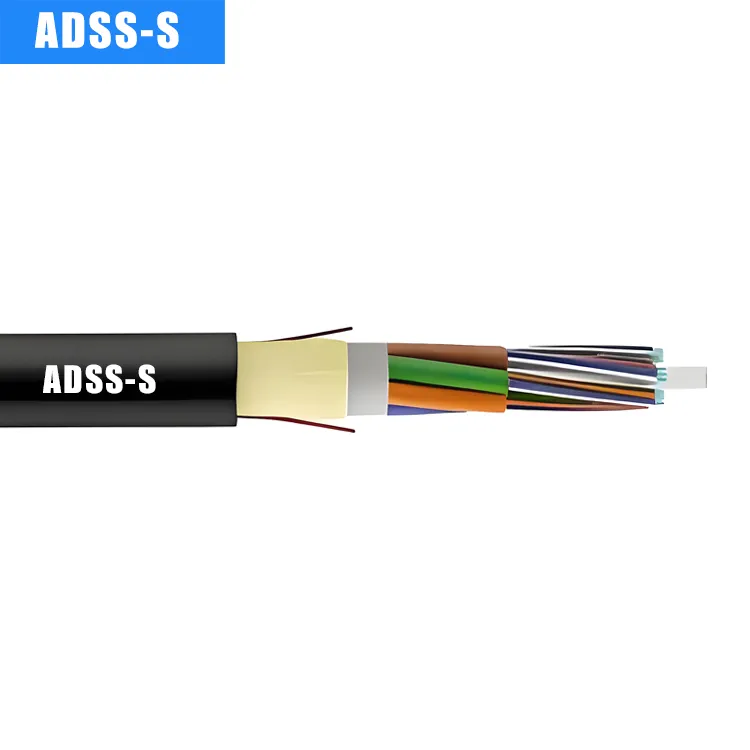
Take YRTFiber's ADSS-S page as an example. It describes an all-dielectric self-supporting single jacket aerial cable with PE or AT outer jacket options, from 2 to 288 fibers. But there's also a technical table showing different working tensions and span ranges for different designs. That alone tells you: this isn't just about "how many cores do I need?"
The short version - choose in this order:
Span first - it decides the basic mechanical design.
Voltage level / electrical environment second - tells you whether you need PE sheath or AT sheath.
Fiber count third - sure, capacity matters, but it needs to fit the mechanical and environmental design, not override it.
Why this order? Because ADSS isn't just a fiber carrier. It's a self-supporting aerial cable that has to handle wind, tension, installation stress, and years of outdoor exposure. Both IEEE's scope and YRTFiber's product structure reflect that.
Step 1: Span length
Span is your first filter. It directly affects cable loading and tension. In YRTFiber's ADSS-S table, different design rows show daily max working tension, break strength, and span values - roughly from 100 m up to 800 m, depending on the configuration.
One thing their page also shows (maybe unintentionally) is that you shouldn't trust a single headline span number. The same product is called a "150 m span aerial cable" in the title, the FAQ says "designed for spans up to 150 meters", a technical block says "max span 100 m", but the feature list says "can reach more than 1000 m", while the table shows designs up to 800 m. What gives? Simple: span depends on the exact design row and your project conditions. So the safe move is to ask the supplier to confirm the design for your actual route, not just go by the marketing words.
Bottom line: span is a design variable, not a fixed label. Short, standard route? A lighter single-jacket might work. Longer route or higher loads? Get a span-specific design confirmation before ordering.
Step 2: Voltage level or electrical environment
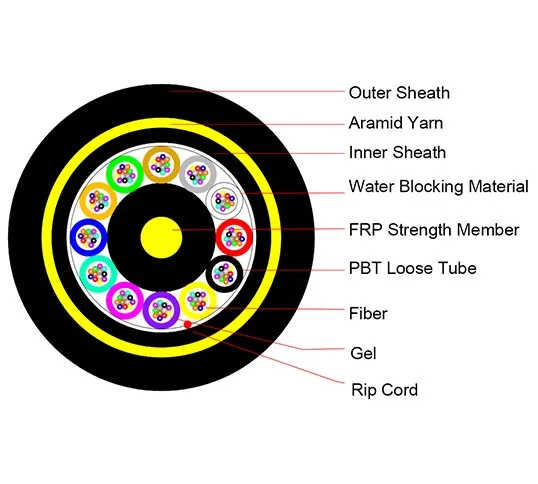
Once you know the span, look at the electrical environment. That's where you choose between PE and AT sheath. YRTFiber's ADSS-S page lists both as outer jacket options, with aramid yarn reinforcement inside.
Industry practice (based on standards like YD/T 980-2002, DL/T 788-2016, GB/T 18899-2002) says: if space potential in the installation area is no higher than 12 kV, go with black polyethylene (A-class sheath). If it's above 12 kV, you want tracking-resistant polyolefin (B-class sheath). In plain procurement language: PE for less severe electrical environments, AT when you need stronger tracking resistance.
A lot of buyers just search by nominal line voltage, but the real engineering question is the actual electrical stress at the installation position. IEEE 1222 even includes an annex on minimizing electric fields using space potential calculations - that's how core this is to ADSS design.
So from a buying perspective:
Standard aerial telecom or low-risk utility route? PE sheath is probably fine.
Harsher electric-field environment? Go with AT.


